Readers can feel bad design even when they can't name it. They finish a session with a vague sense that their choices didn't matter - that they were moving through a tube that happened to bend left or right a few times. They might not put it into words. They just don't come back.
These five mistakes show up in CYOA games constantly. None of them are prose problems or plot problems. They're structural problems - architecture errors that quietly undermine everything you build on top of them. The good news is that each one has a clear fix, and most of them are cheaper to catch before you've written a thousand words.
1. The Fake Choice
Two options. Different wording. Same outcome.
Players find fake choices worse than no choice at all. When you present a fork and both paths arrive at the same scene with the same paragraph of text, you've taught the player that their input doesn't matter. That lesson sticks. They'll start picking randomly on the assumption that it doesn't matter - and they'll be right.
The fix isn't to make every choice lead somewhere radically different. That way lies an unmanageable story tree (see mistake two). The fix is to make the path feel meaningfully different, even when the destination converges. The same betrayal can happen whether your character trusted or didn't - but if the trusting character is blindsided and devastated, while the suspicious one watches it unfold with grim recognition, those are two genuinely different scenes. Same event. Different emotional truth. Players feel the difference immediately.
The test: if you could delete one option and nothing would change for the player, the other option is also fake. Every choice needs to earn its presence.
2. The Tree That Eats Itself
New writers often sketch a branching story like a real tree: a trunk that splits, splits again, and keeps splitting. It looks good on paper. It destroys you in practice.
Every branch you add doubles the content you need to write. By the fifth fork, if every path is fully independent, you need 32 different scenes for a single moment. Nobody finishes a game structured that way - the branches that get the least attention show it. Underdeveloped scenes, rushed endings, dead ends with a curt "you went the wrong way" and nothing else.
The professional pattern is the diamond: branch out, then converge. Give choices real weight in how they're experienced - different allies, different knowledge, different emotional cost - but plan for paths to rejoin at key story beats. The convergence points aren't cheating. They're architecture. Without them, your story collapses under its own weight before players ever reach the parts you actually cared about.
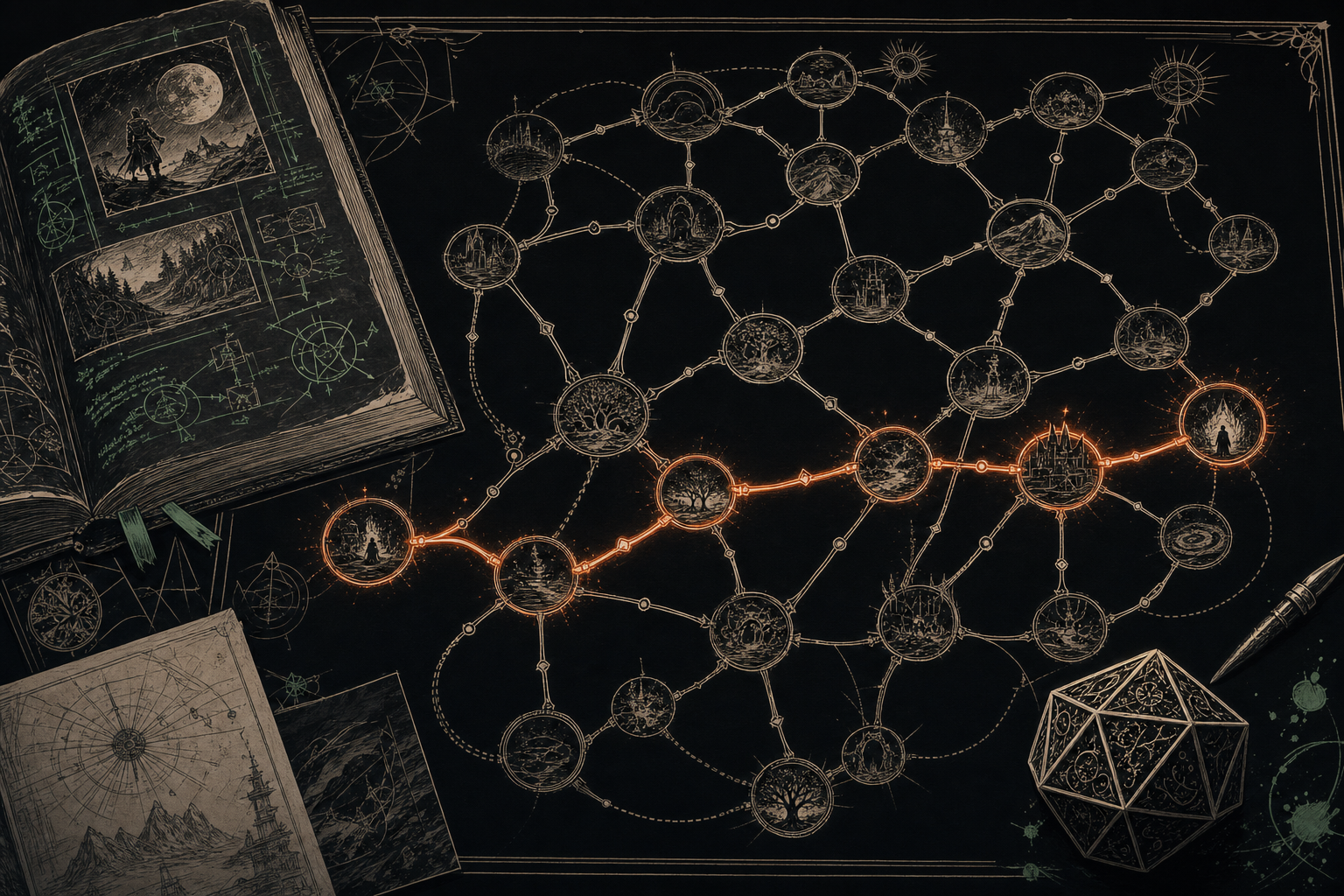
If you're using Dungeon Mastron's visual node-graph builder, you can see these convergence points as you work. Catching runaway branching in a node view is far cheaper than catching it after you've written into a corner. Lay out the structure first, write the prose second.
3. Telegraphing the Right Answer
"Do you help the wounded soldier, or kick him and take his coins?"
Both options are technically available. But the framing, the wording, and the context all announce which one the story was built to reward. Players feel this instantly. They either pick the obviously approved answer (safe, boring, no real engagement) or pick the other one to test the designer's commitment - which usually leads to an underdeveloped branch that confirms they were wrong to deviate.
This is the hardest mistake to fix because it requires a genuine design commitment: both choices have to be defensible from inside the story world, and you have to actually care about writing both of them well. If helping the soldier costs time you can't afford, and taking the coins lets you buy medicine for people you love, that's a real choice. Both positions make sense. Players who pick either one feel like they made a decision, not passed or failed a test.
Respecting both options means understanding both positions. If you find yourself unable to justify choice B, that's a sign you designed a quiz, not a story.
4. A World With No Memory
Your player chose to betray their mentor in chapter one. In chapter three, that mentor appears at the inn, greets them warmly, and asks for their help.
The world forgot.
Variable tracking is what separates interactive fiction from illustrated prose. When the story remembers what you did - when a minor character you helped two scenes ago shows up at exactly the right moment, or when someone addresses you differently because of a quiet choice you made that didn't seem important - that's the moment players realize the story is actually watching them back. It creates a feeling of genuine co-authorship that's hard to achieve in any other medium.
You don't need elaborate state machines for this. A handful of tracked variables - trust level, known information, who's alive, a flag for a single act of kindness - can make a story feel like it has real memory. The Dungeon Mastron builder supports variable tracking for exactly this reason. Even small callbacks land hard. A character who says "I heard you helped my brother" in passing creates more engagement than most plot twists.
The absence of memory is especially damaging in longer games. Players become desensitized when they notice the world resets between chapters. Once that trust breaks, it's almost impossible to rebuild.
5. Every Ending as a Verdict
The most common ending model in CYOA: one good ending, several bad ones. Make the right choices, get the reward. Make wrong choices, get punished.
The problem is that this frames the story as a test with a passing grade rather than an experience with different shapes. Players who hit a "bad" ending don't feel like they explored a different path - they feel like they failed to find the real story. They replay now looking for the approved sequence. Genuine replayability drops, because there's nothing interesting to discover on the wrong side of the fence.
Better design treats every ending as a different kind of story - not a different score. A tragic ending where your character achieves nothing but dies surrounded by people who loved them isn't a bad ending. It's a specific ending, with its own emotional truth, and it deserves to be written with full craft rather than as a consolation prize.
This is what the best interactive fiction consistently does. You can play games in the Dungeon Mastron library and notice the pattern in the ones that stick with you longest: they don't rank their endings. They just write them. Every path leads somewhere complete.
If you want to study this in the wild, the IF Comp archives are worth an afternoon. Thirty years of competition entries from writers who thought hard about this exact problem - and whose experiments, successes, and failures are all publicly playable.
These Are Architecture Problems, Not Writing Problems
A beautifully written CYOA with all five of these structural problems will still leave players vaguely unsatisfied. A rough, spare story that gets the structure right will feel honest and memorable.
The structural work happens before you write prose. It happens in the sketch phase - in the node map, in the document where you track what each choice actually costs and earns in story terms. Catching a fake choice or a runaway branch when it's a box on a diagram is far cheaper than catching it when it's eight pages of prose you're now reluctant to cut.
If you're building your first branching story, the Dungeon Mastron visual builder is free and runs in your browser - no account, no install. Sketch the structure, spot the problems early, then write. The AI Companion template is also worth looking at if you want help generating branching scene variations once the architecture is solid.
Come talk structure in the Dungeon Mastron Discord. The design questions - the ones about choices and consequences and when to converge - are always the most interesting ones to work through together.
Build your own story game
The Visual Builder is free, open source, and runs in your browser. No account needed.
Open the Visual Builder