The shape that keeps stories finishable
A branching story should feel bigger than the document behind it. That is the job. The trap is assuming that every choice needs to create a completely separate future. It does not. In fact, if every choice forks forever, most solo projects become an unfinished map full of promising corridors.
The practical answer is the branch-and-merge pattern: let a choice create a distinct moment, then bring the paths back together at a later scene. You keep the feeling of agency without asking yourself to write eight different novels.
What branch and merge actually means
A branch is the immediate consequence of a player decision. The merge is a later story beat that both paths can reach.
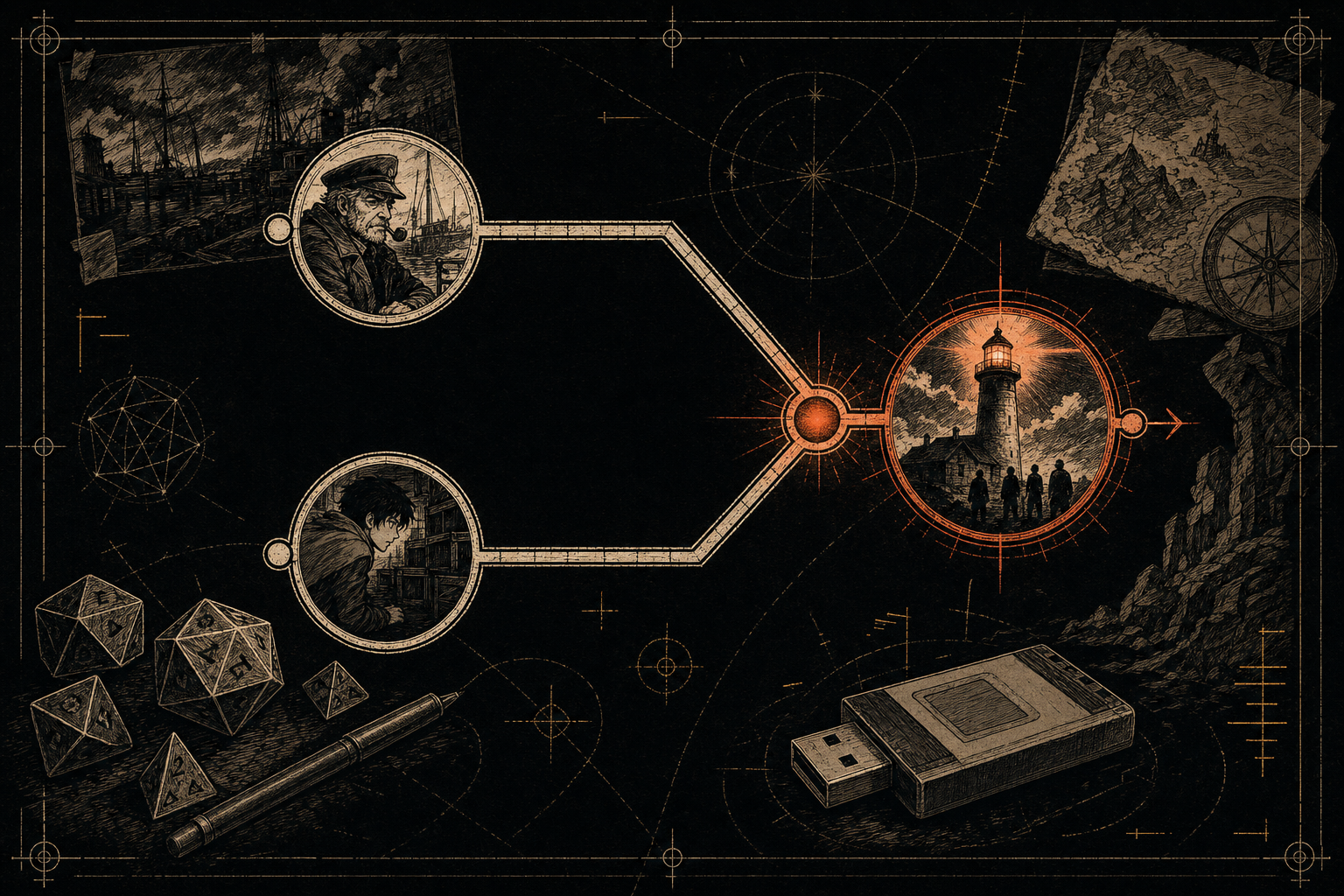
Imagine an investigation game. The player can question the dockmaster or sneak into the warehouse. Those should not be cosmetic choices. Each route can reveal a different clue, create a different risk, and give the player a different picture of the situation. But both can lead to the same midnight meeting at the lighthouse.
That lighthouse scene is the merge. It is not an admission that the earlier choice did not matter. It is a way to control scope while carrying the choice forward through state, dialogue, inventory, injuries, trust, or knowledge.
In a node graph, the shape is simple:
Arrival
  ├─ Question the dockmaster ─┐
  └─ Sneak into warehouse ───┤
                              └─ Lighthouse meeting
The two routes need enough room to breathe before they reconnect. One paragraph and an identical outcome will feel fake. A small scene with a different problem, a different discovery, and a consequence that survives the merge will feel like a real decision.
Why permanent branching becomes a production problem
There is nothing wrong with a story that permanently splits. Sometimes that is exactly the point. A short game can commit to two sharply different routes, and a finale can split into several endings.
The danger is doing it by default.
If every scene has two choices and neither reconnects, five decisions can create 32 possible paths. At ten decisions, it is 1,024. You do not need to write every path at equal length before this becomes difficult to test, pace, and revise.
More importantly, permanent branches dilute your attention. The exciting scene you want to polish becomes one of many variations. Important characters disappear on half the routes. A clue that matters in one branch becomes dead weight in another. The game grows, but it does not necessarily get deeper.
Branch and merge gives you a useful budget. Spend distinct scenes where the player should feel the choice in their hands. Rejoin when the story needs a shared turn, a fresh question, or a moment of momentum.
A merge is only honest if something crosses it
The quickest way to make a merge feel dishonest is to erase the branch at the doorway. If the warehouse route and dockmaster route arrive at the lighthouse with the same knowledge, same tools, same dialogue, and same emotional temperature, the player notices.
Carry at least one thing across. Usually, two is better.
- Knowledge: the dockmaster names the traitor; the warehouse reveals a shipping mark. Both point forward, but they change what the player can infer.
- Resources: one route earns a key; the other costs a lockpick or gains a map.
- Relationships: a guard remembers being deceived, or an ally trusts the player because they were asked for help.
- Tone: arriving muddy and chased is different from arriving composed with a bargain in hand.
- Options: both paths reach the meeting, but each unlocks one choice there that the other route cannot take.
This is a good use for variables and flags. You do not need to keep the whole story split to preserve history. A flag such as met_dockmaster or warehouse_alarm lets a later node react to what happened. Dungeon Mastron's visual builder is useful here because you can see the shared node and the route-specific nodes together instead of losing the structure in a long document.
Design branches around different verbs
Players can smell fake choice when both buttons mean the same thing in different clothes. “Go left” and “go right” are not automatically different decisions. They become meaningful when they ask for different instincts.
Try pairing verbs that create distinct story experiences:
- ask or steal
- hide or confront
- protect someone or pursue the objective
- spend a resource or accept a risk
- trust a witness or test their story
Each verb should give the player a reason to choose based on who they think they are in this world. That is stronger than presenting one obviously correct option and one failure button.
The same principle helps when you write with the AI Companion. Ask for branches with different methods, costs, and information, then decide where they can responsibly reconnect. AI can produce options quickly. Your craft is deciding which differences deserve to echo later.
Place merges at natural story turns
A merge works best when the story has a reason to gather everyone back into the same place. Good merge points often include:
- a deadline arrives
- the antagonist acts
- the party reaches a fixed destination
- a public event begins
- a new piece of evidence changes the goal
- the player returns to a home base
These are story turns, not plumbing. The lighthouse meeting works because both investigations were always heading toward the person who called it. The merge feels inevitable in hindsight.
Avoid merging immediately after the decision unless the choice is deliberately tiny. Let the player solve one local problem first. A useful rule of thumb: each branch should contain a scene the other branch cannot show.
Use branches to change the question, not just the route
The strongest branching choices do more than choose a location. They change what the player is worried about.
In one route, the player may wonder whether the dockmaster is lying. In the other, they may wonder whether the warehouse is a trap. When both routes merge, those questions can collide: perhaps the dockmaster's name is stamped on the crates.
That is where branching narrative gets satisfying. The merge creates a new question informed by whichever experience the player had. The story becomes denser rather than wider.
You can see this in a small playable prototype before writing the full game. Build three or four nodes, test both routes in the browser player, and ask a blunt question: would I describe these as two different experiences to a friend? If not, change the branch or cut it.
Keep a merge ledger while you build
For every planned merge, write down three short notes:
- What is different when the player arrives?
- What does the shared scene remember?
- What new decision does that difference affect?
If you cannot answer those questions, you probably have a fake branch. That is not a disaster. It may simply be one scene that does not need a choice.
A tiny ledger also prevents continuity mistakes. You will know that the player can only use the lighthouse key if they took the warehouse route, or that an angry guard should not appear in dialogue unless the alarm flag exists. This matters even more when you move from a paper outline to a physical build. A Dungeon Mastron Pi console makes a compact story feel wonderfully like an object, but it does not make an untested maze easier to debug.
Endings are where you can let the tree open again
The middle of a CYOA benefits from controlled merges. The ending is a good place to spend the saved complexity.
Let accumulated choices decide the final shape: who trusts the player, what they learned, whether they kept a tool, or how much damage they accepted. This creates replay value without requiring an entirely separate campaign for every early button press.
That approach also fits the argument in Wounds, Not Death: Better Stakes for Story Games. Consequences can persist and alter later scenes without throwing the player out of the story at the first bad roll.
Branch and merge is not a shortcut around design. It is design. It asks you to decide which consequences deserve pages and which can become a scar, a key, a memory, or a changed line of dialogue. Start small, make each branch genuinely different, and let the story gather itself when it has somewhere meaningful to go.
If you are sketching a story map this week, try it in the no-code builder. And if you want to compare maps, prototypes, or unusually stubborn merges with other makers, join the community on Discord.
Build your own story game
The Visual Builder is free, open source, and runs in your browser. No account needed.
Open the Visual Builder