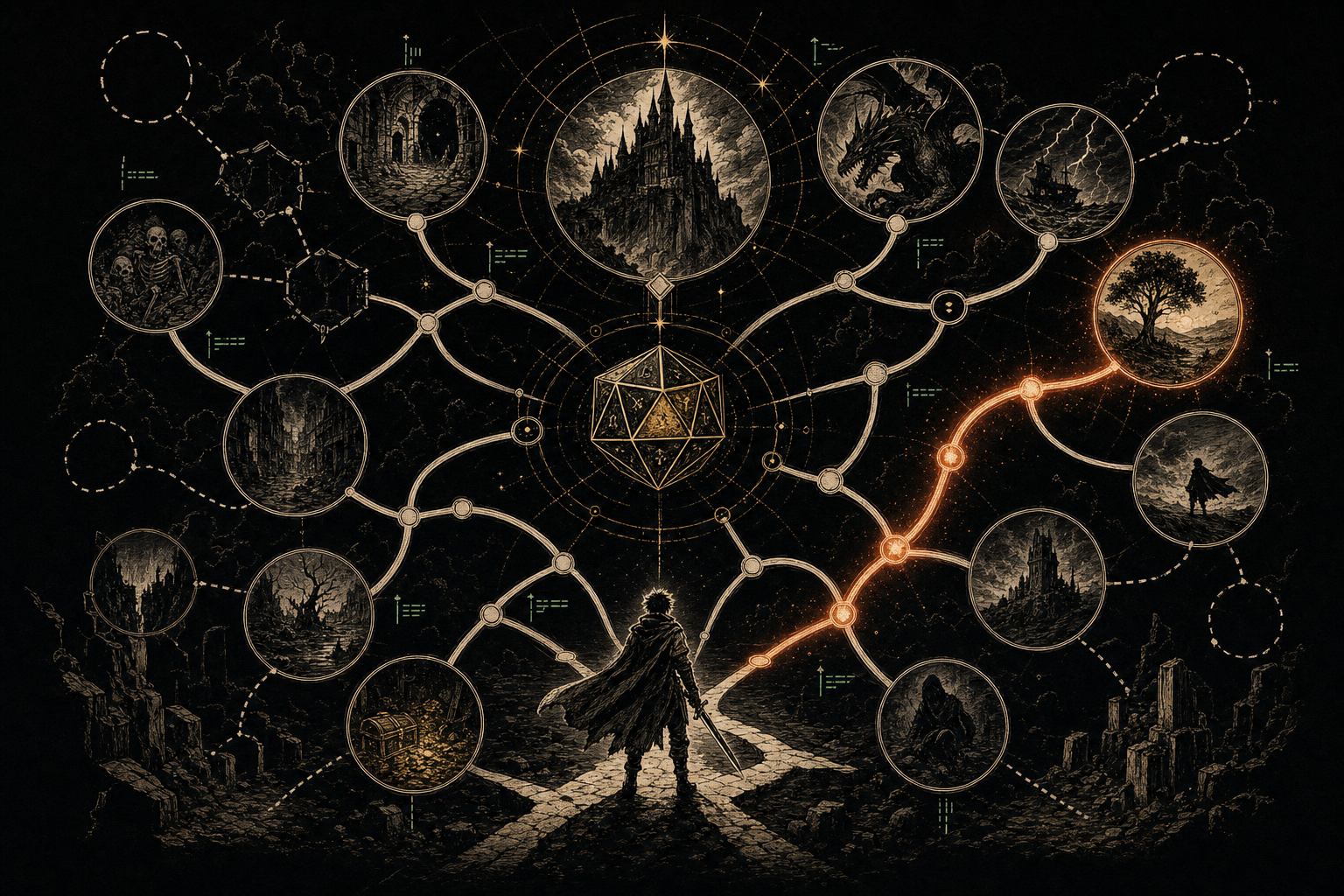
Everyone who grew up with the classic Choose Your Own Adventure paperbacks remembers the ritual: you make a bold choice, turn to page 83, and – you have been eaten by the shark. THE END. Fingers wedged between pages as save points. Flip back, pick the other option, pretend it never happened.
It was charming in 1982. But as a design pattern, sudden death is the weakest thing failure can do in a story game – and it quietly teaches players the worst possible lesson: don't engage with the choices, just find the correct path.
What "game over" actually does to a story
Think about what happens, structurally, when a branching game kills the player:
- It erases the choice. The player restarts or rewinds, and the fiction proceeds as if the choice never occurred. The one thing your game exists to offer – consequence – is nullified.
- It converts drama into puzzle. Once players learn that wrong answers mean restarting, they stop asking "what would I do?" and start asking "what does the author want?" The story becomes a lock to pick.
- It punishes curiosity. The most interesting choice on the page is often the risky one. If risk reliably means death, you've trained players to be boring.
- It wastes your writing. A death page is a dead end you wrote that most players will experience as an interruption, not as story.
None of this means stakes are bad. Stakes are everything. The question is what failure costs – and there are far more interesting currencies than existence.
The alternative: failure bends the story
The design philosophy at the heart of Dungeon Mastron is simple to state:
When the player fails, don't end the story. Wound it. Let them keep playing – as someone carrying that wound.
The player who got caught sneaking into the manor doesn't get a game-over screen. They get dragged before the countess – a scene the careful player never sees. The player who trusted the smuggler and got betrayed doesn't restart; they arrive at the port broke, angry, and with a name to curse. The story continues. It's just bent now.
Failure becomes content instead of a wall. And something subtle happens to the player's psychology: choices become expressive rather than tactical. You're not solving the author's maze anymore; you're finding out who you are in this story, one scar at a time.
What wounds look like in practice
A "wound" is any persistent consequence that travels with the player after a failure. In a branching game, the practical toolbox looks like this:
- Physical marks. A limp from the fall means the rooftop escape later is no longer offered – a different route appears instead. The player feels the old choice in the new scene.
- Lost things. The lantern went into the river. Every dark place for the rest of the game is now a different, tenser scene.
- Burned relationships. The innkeeper saw you lie. She's still there in act three – and she remembers. Recurring characters who react to old failures are the cheapest, highest-impact wounds you can write.
- Reputation and knowledge. Word travels that you fled the fight. Or conversely: failing the heist taught you the guard rotation – a wound that carries a hidden gift.
- Diverted paths. The boldest version: failure routes the player onto an entirely different branch – captured instead of escaping, shipwrecked instead of arriving. Some of the best scenes in any branching game live on failure paths, precisely because only the players who earned them will see them.
Notice that these are all cheaper to write than they sound. You don't need a parallel story for every failure. Structurally, most wounds are the branch-and-merge pattern (which we cover in our beginner tutorial): paths split, diverge for a scene or two, then rejoin the spine – but the rejoining player carries a flag that colors scenes downstream. One variable, a handful of alternate paragraphs, and the whole game feels alive to your history.
"But doesn't death have its place?"
Sometimes, yes – honesty demands the caveat. Death endings can work when:
- They're endings, not interruptions. A death in the final act, written with as much care as a victory, is a legitimate ending – the tragedy route. That's different from a mid-game trapdoor.
- The game is short and replay is the loop. In a ten-minute game designed to be replayed, deaths function like verses of a song. The Choose Your Own Adventure books lived here.
- The genre demands it. Survival horror without the possibility of dying is toothless. But even here, the interesting versions make each death reveal something, so dying is progress.
The principle isn't "never kill the player." It's: death should never be the lazy default consequence. If a failure page exists only to say "wrong, go back," it can almost always be replaced by something that moves the story forward in a worse direction – and "worse direction" is where drama lives.
Why replayability comes free
Here's the economic argument for busy writers. In a death-based game, the failure branches are content most players skip past as fast as possible. In a wound-based game, every branch is real story – which means a second playthrough isn't "the same game, played correctly," it's a different life. Players replay not to fix mistakes but to find out who else they could have been. That's the deepest hook interactive fiction has, and it costs you nothing but a shift in how you write consequences.
Try the philosophy, not just the tool
This idea is tool-agnostic – it will improve a Twine game or a tabletop campaign just as much as a Dungeon Mastron game (we compare tools honestly here). But it's baked into how Dungeon Mastron works: the Visual Builder's node canvas makes branch-and-merge wounds easy to see and wire, and the AI Companion template explicitly instructs the AI to write failure as diversion, not termination. You can feel the difference in the featured games – go make a genuinely bad choice in one, and watch the story lean into it instead of slapping your hand.
Build a game where failure matters: open the Visual Builder and write one branch where things go wrong interestingly. Or come argue about death endings with us on Discord – design talk is what it's for.
Build your own story game
The Visual Builder is free, open source, and runs in your browser. No account needed.
Open the Visual Builder